Turning a Room Into a Website You Can Walk Through
Saw a reel one morning, tried it before lunch, posting by evening: your phone can turn a room into something you walk around inside on a webpage — it's called Gaussian splatting. Here's what it is, what a good one looks like, and how anyone can make one in about ten minutes.
Saw a reel one morning. Tried the thing it showed before lunch. It’s evening and I’m writing this. That’s the whole backstory.
The thing: your phone can turn a room into something you walk around inside — on a webpage, with your mouse. It’s called Gaussian splatting. I tried it on my own room; that one’s staying private (you really don’t need a 3D tour of my laundry pile), but here’s what it is, what a good one looks like, and how you — or I, for you — can make one.
What even is “Gaussian splatting”?
Until recently there were two ways to make 3D on a computer. Polygons — the LEGO-brick approach, triangles and textures, what games and films use. Looks great; takes an artist weeks. And photogrammetry — you feed a computer a couple hundred photos and get a soft, melty mesh back. Faster, less pretty.
Gaussian splatting — a 2023 research idea now living inside free phone apps — is a third way. Your scene is made of millions of tiny, fuzzy, coloured blobs floating in 3D space — “splats.” Squint and they blur together into something that looks photoreal from every angle. It runs at 60fps in a browser, and the files are small enough to email.
It isn’t magic — it’s maths fed by photos — so the photos have to be decent. But “decent” is now a ten-minute job, not a film shoot.
Why would anyone want this?
“Come see the space” is expensive; “here are 12 photos” is flat. A splat is the in-between: a real place, captured once, that anyone can wander through from their couch. Estate agents, Airbnb hosts, wedding venues, restaurants, showrooms, museums — anywhere “show, don’t tell” beats a photo gallery. So you can do this yourself — or, if you’d rather not, I can set it up for you and hand you a link to drop on any website.
The recipe (genuinely ~10 minutes)
- Grab a free app — Scaniverse (iOS/Android, by Niantic, no account, processes on the phone itself) or Luma AI (cloud-based).
- New scan → “Splat” mode → room-size preset.
-
Walk the room slowly, painting every surface. The app draws a glowing wireframe over everything it’s “seen.” Do three loops — knee height, eye level, high looking down — and get the corners and behind the furniture. Smooth, continuous motion; no stop-and-snap. (A lived-in, well-lit room scans better than a staged-empty one.)
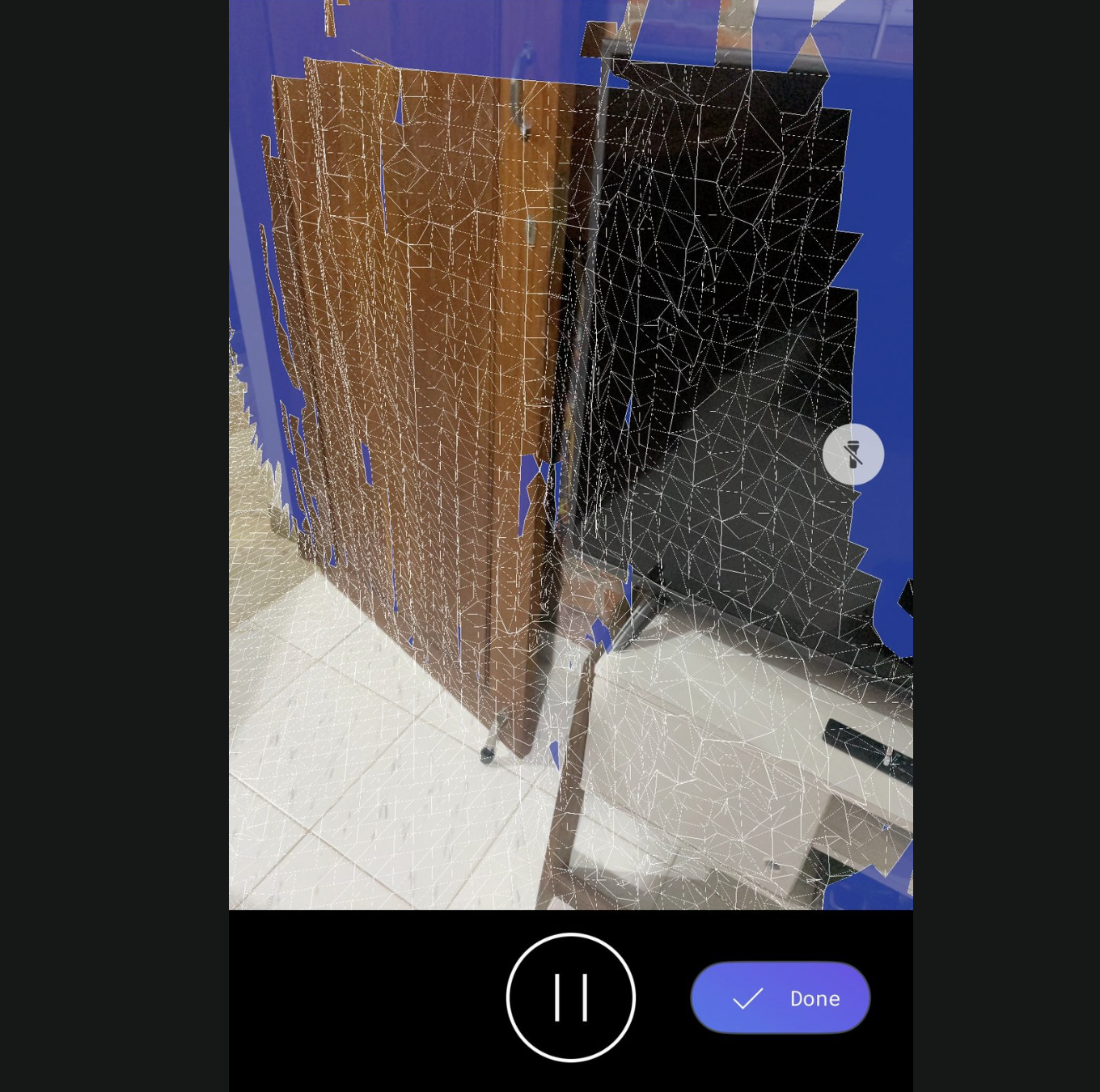 Mid-scan. That shimmering wireframe is the app keeping track of what it’s captured. Keep moving until the whole room is painted in.
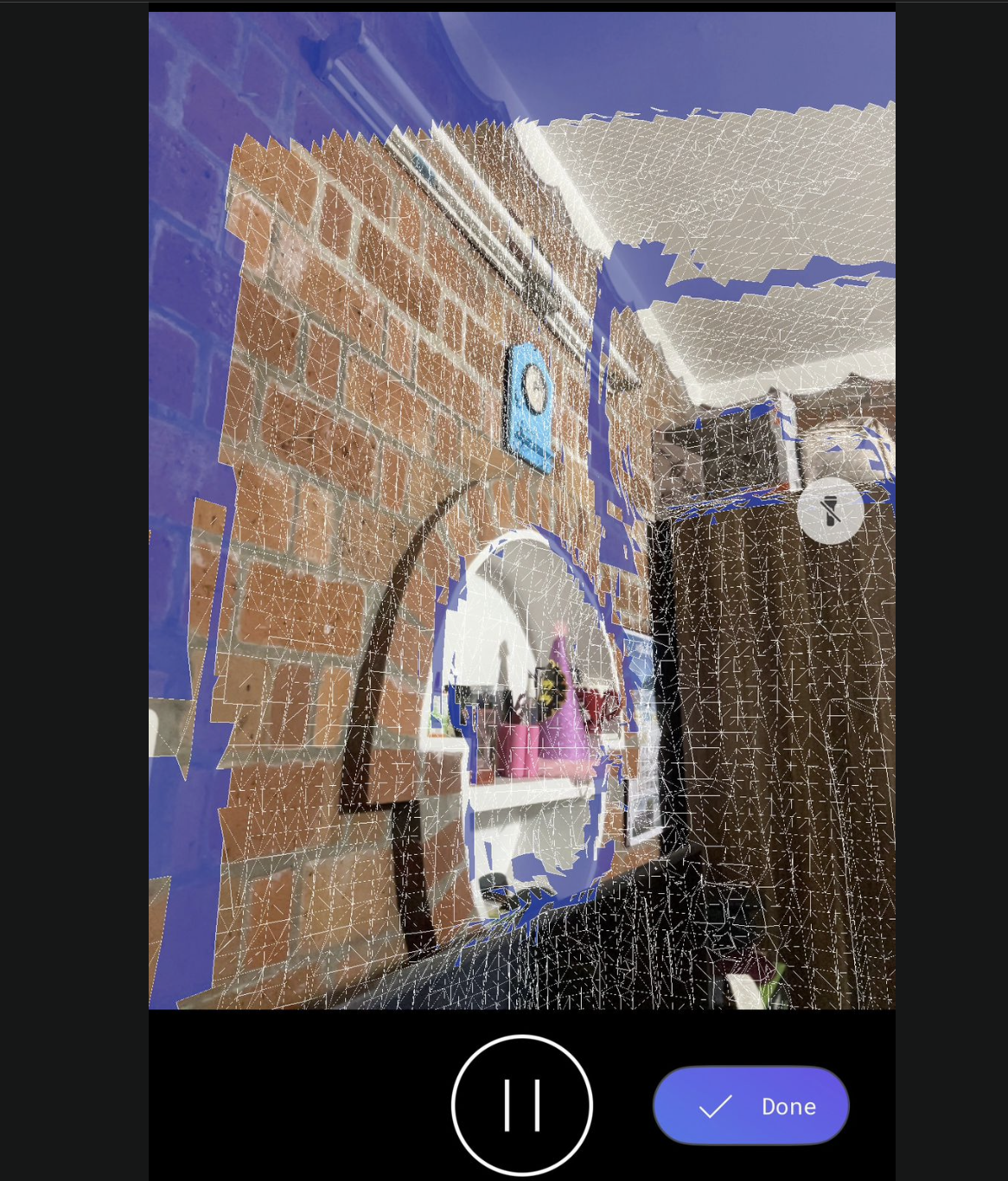 More of the same — slow, overlapping passes, every angle.
 -
Tap Done. It processes for a minute or two:
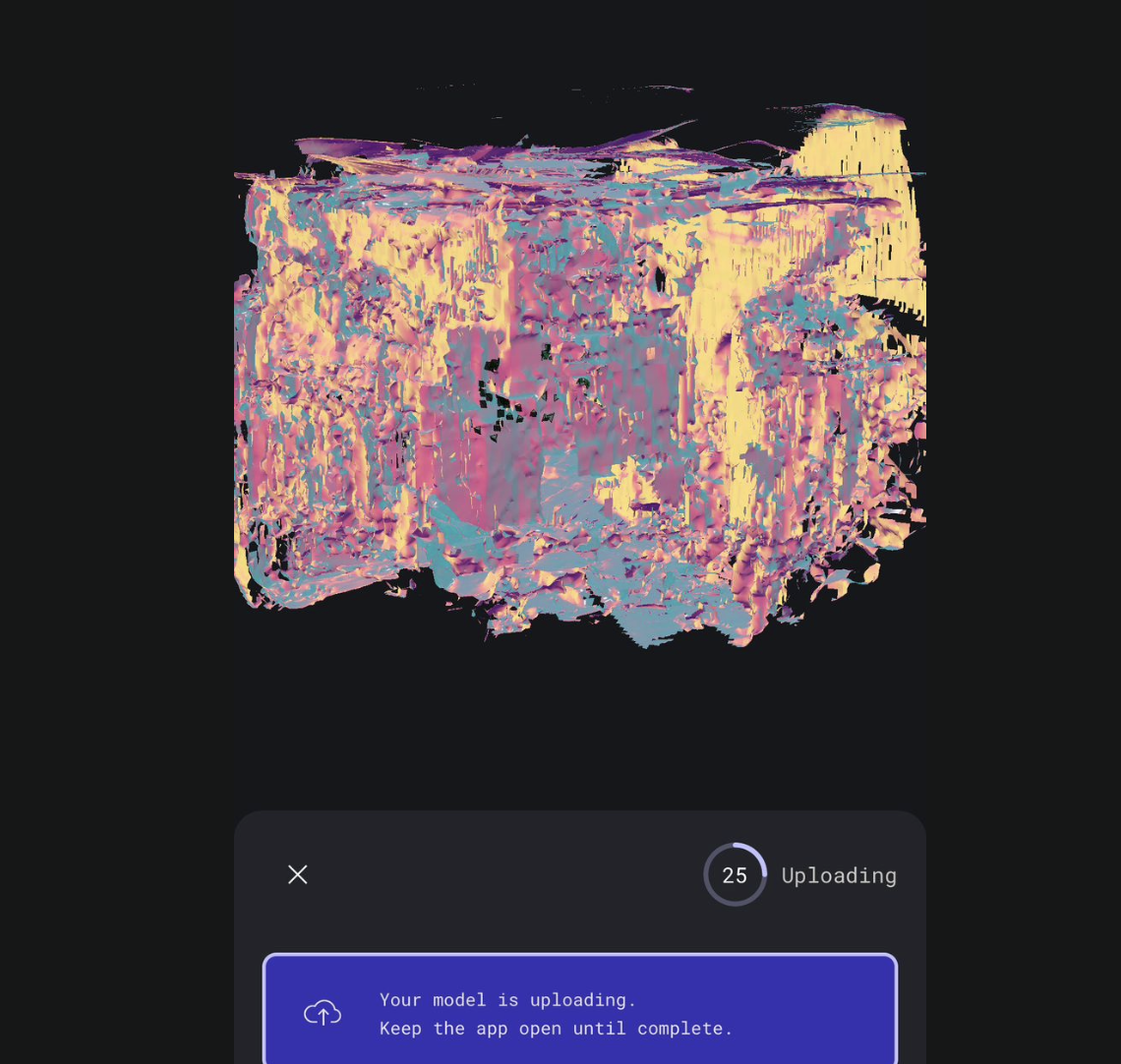 Briefly, your room looks like abstract art. That’s just the processing step — totally normal.
 - Tidy it up (free, in your browser) with SuperSplat — crop away the stray bits, done. Fun fact: SuperSplat is open source — github.com/playcanvas/supersplat.
- Share or embed the link.
No rig, no render farm, no degree.
So how did mine turn out?
I shot my room in about two minutes, in so-so light, and got back something recognisably a room — just a soft, dim, first-try one — so I’m keeping that one to myself. But it taught me the single thing worth knowing here: a great splat is almost entirely about the capture. Light, patience, coverage. A real camera helps; technique helps more.
What “good” actually looks like
Here’s the exact same technology in skilled hands — “2508 Paramount House,” captured by cameroncone, who built it specifically as a real-estate proof-of-concept. Real camera, careful lighting, hours of patience:
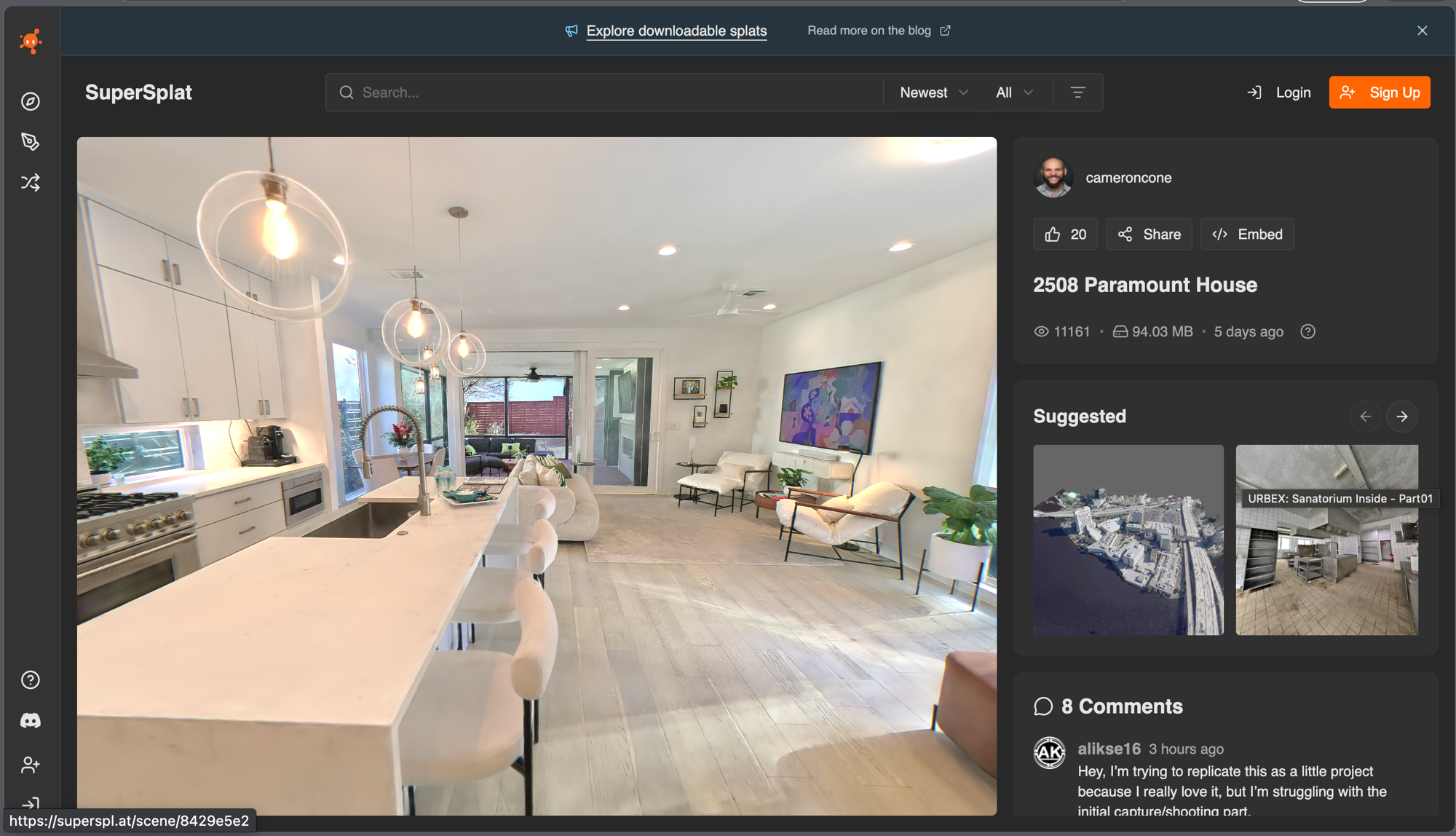
👉 Walk through a few of these yourself → — drag to look around, WASD to move. (Opens an interactive demo page; it’s a little heavy, so it gets its own room.)
That gap — between a two-minute phone scan and that house — is the whole story. The tech is democratised; the craft is catching up fast.
Want one?
Got a space worth showing off — a room, a studio, a shop, a property, a venue? Two options: DIY it with the recipe above (genuinely a lunch-break job), or have me do it — I’ll capture it properly, tidy it up, and hand you an embeddable link that works on any website.
3D used to be something you watched in a cinema. Now it’s something you can make on the bus home. Go scan something — maybe close the blinds first.
Got work a robot should be doing?
I build agentic systems, tax-automation bots and websites for founders, operators and CA firms. If a workflow is eating your team's week, let's fix it.
[ WORK WITH ME → ]