An Engineer Got Laid Off by Atlassian — and Gave a Masterclass on the Way Out
A systems engineer was laid off by Atlassian after 8 years — and answered with a 38-minute video explaining every system he built. I turned it into a structured written breakdown: load balancers, an Envoy control plane, ~2,000 proxies across 13 AWS regions, and the engineering lessons underneath.
A couple of weeks ago, a systems engineer named Vasilios Syrakis posted a video titled “I was laid off by Atlassian.” Eight years at the company, ended in a 10% workforce cut. You brace for a vent. It isn’t one.
It’s 38 minutes of him calmly walking through the systems he built — no internal code, no data, no customers, just architecture. How Atlassian swapped expensive enterprise load balancers for open-source proxies. How he built the control plane that reconfigures around 2,000 of them across 13 AWS regions, live, with no restarts — and open-sourced it. How those servers get baked, how authentication got centralised at the edge, and the part most engineers skip entirely: how you keep all of it maintainable for eight years without it quietly rotting.
It’s a quiet masterclass, and it’s earned its million-plus views. Honest, specific, generous engineering knowledge — given away for free, with full goodwill toward the company that just let him go — is rare enough to be worth studying properly.
Which was the one snag. It’s a 38-minute video. Brilliant to watch once; painful to skim, reference, or come back to.
So I fixed that. I pulled the full transcript, cross-checked it against the open-source repos and public docs, and rebuilt the whole thing as a structured written breakdown — every system explained in depth, architecture diagrams, an API reference table, a glossary, and the request path traced end to end. Colour-coded, skimmable, and linked all the way back to him.
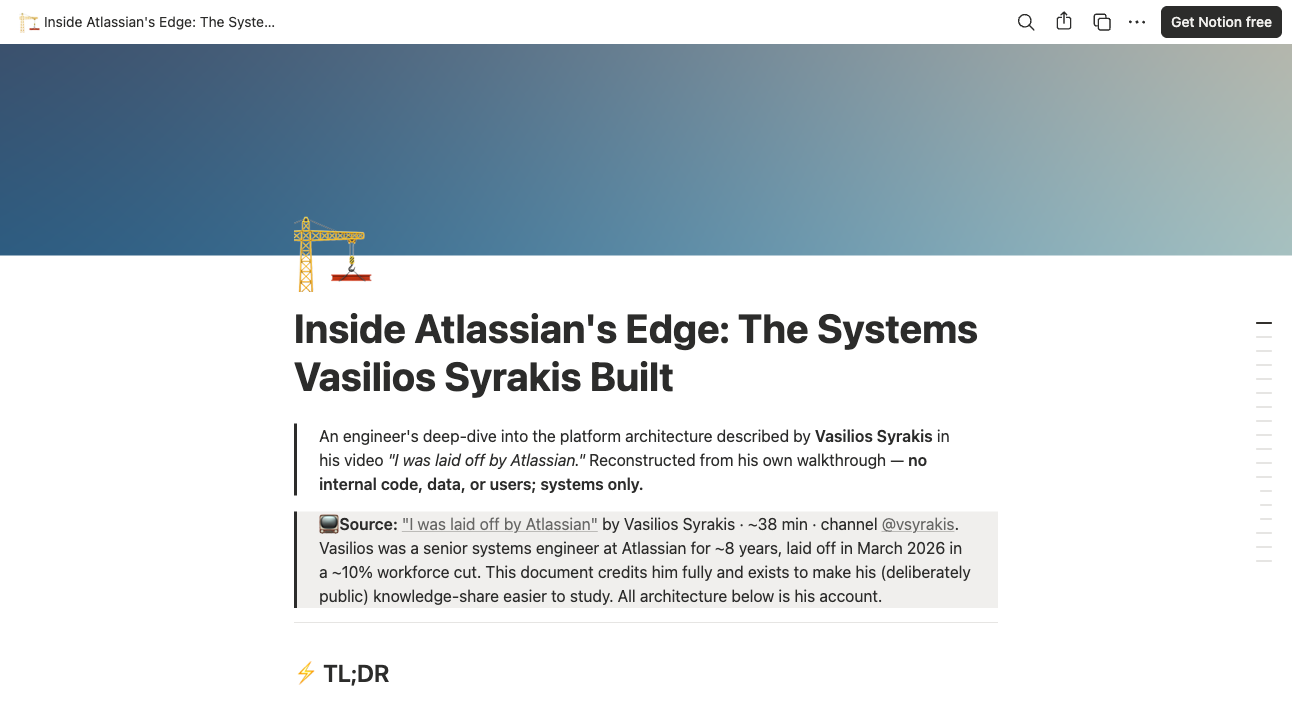 The breakdown — five core systems, mapped out and cross-referenced.
It’s pitched at engineers, but it’s laid out so anyone curious about how a large software company actually runs under the hood can follow the thread — five core systems, and then the human ones: diplomacy, mentoring, and the “churn smell” that warns you a codebase is about to turn.
All the credit here is his. Watch the original video and follow his channel — the breakdown just makes it easier to study, and to keep.
Got work a robot should be doing?
I build agentic systems, tax-automation bots and websites for founders, operators and CA firms. If a workflow is eating your team's week, let's fix it.
[ WORK WITH ME → ]